
18 Round Nail Designs for Short, Practical Nails
Round nails are short nails filed into a smooth curve that follows the natural shape of the fingertip. They are the most practical nail shape there is: no corners to catch, no points to snap, and they suit hands that type, cook, garden, and live real life.
This guide covers 18 round nail designs organized by what each design actually does for short nails: designs that forgive chips and wear, designs that create the illusion of length, art scaled to fit a small canvas, and looks that still look good three weeks in. You will also find honest guidance on who the round shape suits, how round differs from oval, and how to file the shape at home.
What Are Round Nails?
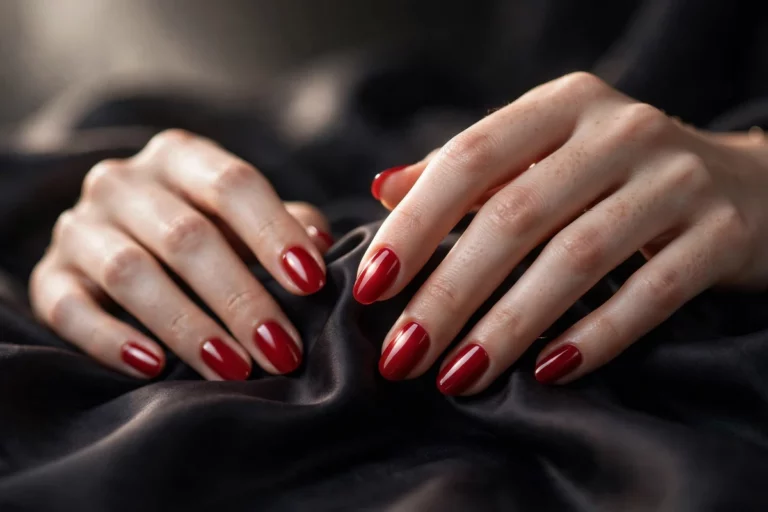
Round nails are nails with a curved free edge that mirrors the fingertip, worn short. The sidewalls taper gently into a semicircle rather than ending in a point or a flat edge.
Round is the shape most natural nails grow into when they are simply trimmed and smoothed, which is why it reads as effortless rather than sculpted. Because the edge is one continuous curve, there are no corners to catch on fabric or chip against keyboards, and the short length means less leverage on the nail when it takes a knock. Nail techs consistently recommend round as the starter shape for anyone growing out bitten or damaged nails, since it keeps the free edge short while the nail bed recovers.
Round vs Oval: Why They Get Mixed Up
Round and oval are not the same shape. Round nails are short with a curved tip that follows the fingertip; oval nails are longer, with the sides tapering into an egg-shaped tip that extends past the fingertip.
The confusion comes from product packaging and salon menus, which sometimes use the names interchangeably. The practical difference matters: round is the strongest, lowest-maintenance of the two because the short length and curved edge distribute stress evenly. Oval looks more elegant and elongating, but it needs more length to read correctly and breaks more easily. If your nails are short and you want them to look tidy with minimal effort, ask for round. If you have some length and want fingers to look longer, oval is the better request. Our nail shapes guide breaks down every shape side by side.
Who Do Round Nails Suit Best?
Round nails suit almost everyone, but they are the best choice for short fingers, wide nail beds, and active lifestyles. The curved edge softens wide nails, and the short length keeps hands looking neat even when a manicure is a week old.
Be honest about the trade-off: round will not give you the dramatic, elongating effect of almond or coffin. What it gives you instead is durability and ease. This is the shape for people who use their hands hard, who bite their nails and want a forgiving shape to grow into, who type all day, or who simply prefer a manicure that looks good without babying. If you love long, sculpted nails, round is not your shape, and that is fine. If you want pretty nails that survive your week, it is hard to beat.
How to File Round Nails
To file a round shape, trim the nail straight across first, then file the corners in smooth, curved strokes from the side toward the center, checking the curve against your fingertip as you go.
The classic mistake is filing too much off the sides, which narrows the nail into an almond point or weakens the sidewalls so they split. Work in one direction with a fine-grit file (180 grit or higher for natural nails) rather than sawing back and forth, and keep the free edge short: round only looks intentional when the tip barely clears the fingertip. Finish by smoothing the edge with a buffer block and pushing cuticles back rather than cutting them. File every week or two to hold the curve, since nails grow out into corners between appointments.
Round Nail Designs at a Glance: Quick Picks
Eighteen designs is a lot to scroll when you already know your problem. Start here instead: find your situation, jump to the design built for it, and read the full entry for the technique.
| Your situation | Reach for | Why it works |
|---|---|---|
| Your manicures chip by day three | Sheer Milky Pink Wash (1), Soft Greige Creme (2) | Sheer and mid-tone finishes hide tip wear instead of announcing it |
| Your fingers look short | Classic Micro French (6), Soft Blush-to-White Ombré (9) | Both pull the eye along the nail, buying visual length the shape does not |
| You are growing out bitten or damaged nails | Sheer Milky Pink Wash (1), Sheer Builder Overlay (18) | Invisible grow-out while the nail bed recovers; the overlay adds real strength |
| You need three weeks out of one manicure | Cuticle Cuff in Deep Berry (16), Sheer Glazed Chrome (15) | The design lives at the base or in a sheer base, so regrowth has nothing to expose |
| You want art, but your nails are tiny | Micro Dot Trio (10), Single-Line Half-Moon (13) | Art scaled to the canvas: one small element, placed where it cannot crowd |
| Strict office or interview week | Soft Greige Creme (2), Bare-Sidewall Nude Stripe (7) | Neutral, quiet, and deliberately understated from handshake distance |
Designs That Forgive: Chip-Hiding Looks for Real Life
These five designs look good even when life happens to them. Sheer bases, mid-tone shades, and busy textures all hide the small chips and tip wear that short nails collect, so the manicure reads as intentional for days longer.
1. Sheer Milky Pink Wash
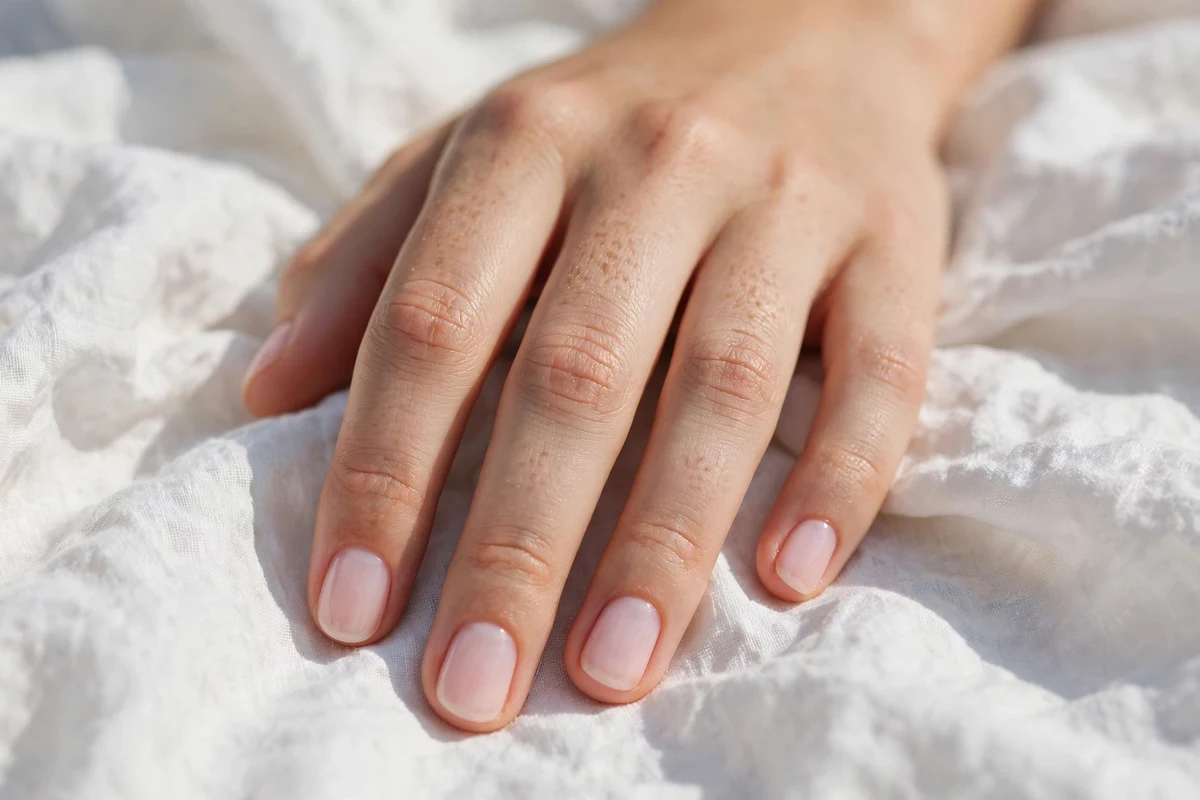
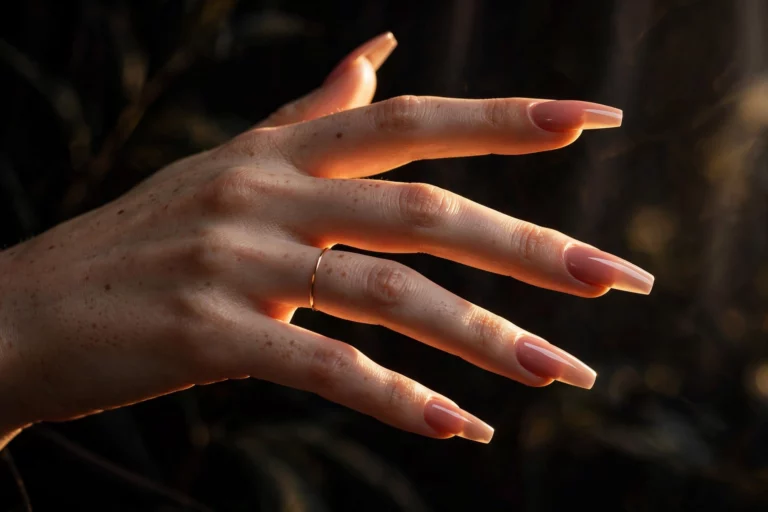
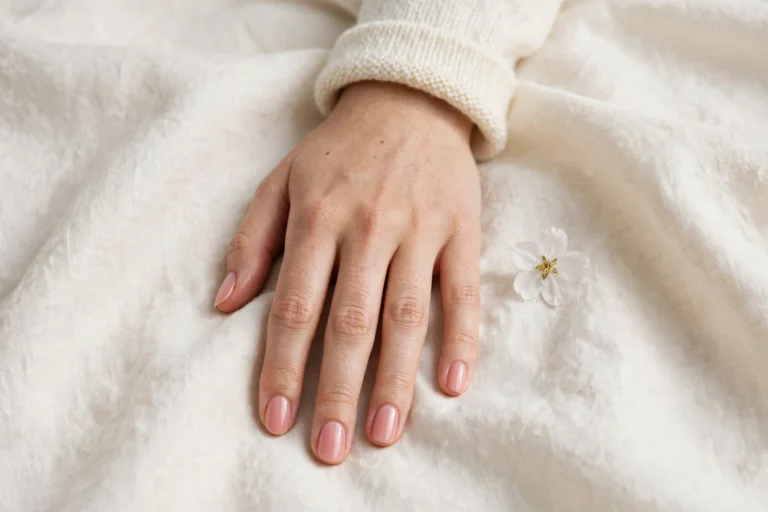
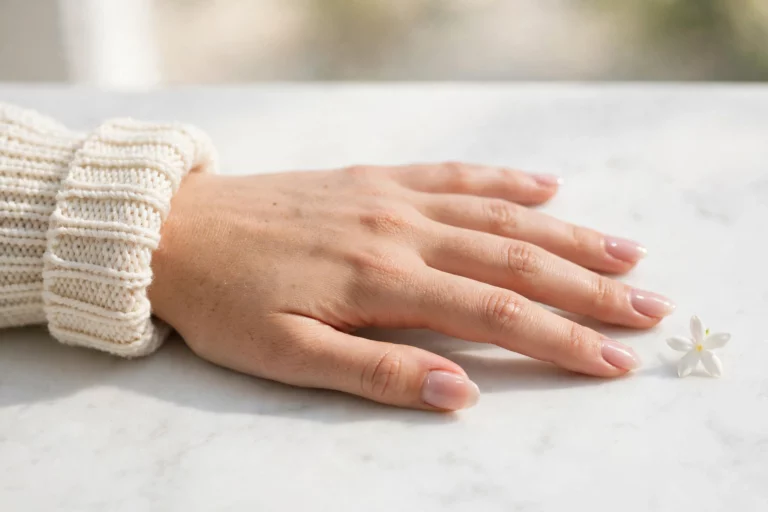
A sheer milky pink wash is the most forgiving manicure in existence. The translucent base lets the natural nail show through, so a small chip at the edge simply disappears into the sheerness instead of flashing bare nail.
This is the easiest DIY design on the list: two to three thin coats of a milky sheer polish, no art skills required. It flatters every skin tone, suits every dress code, and grows out invisibly, which makes it ideal if you are growing out bitten nails or between salon visits. See our milky nail ideas for the full shade range from barely-there to cloudy white.
2. Soft Greige Creme
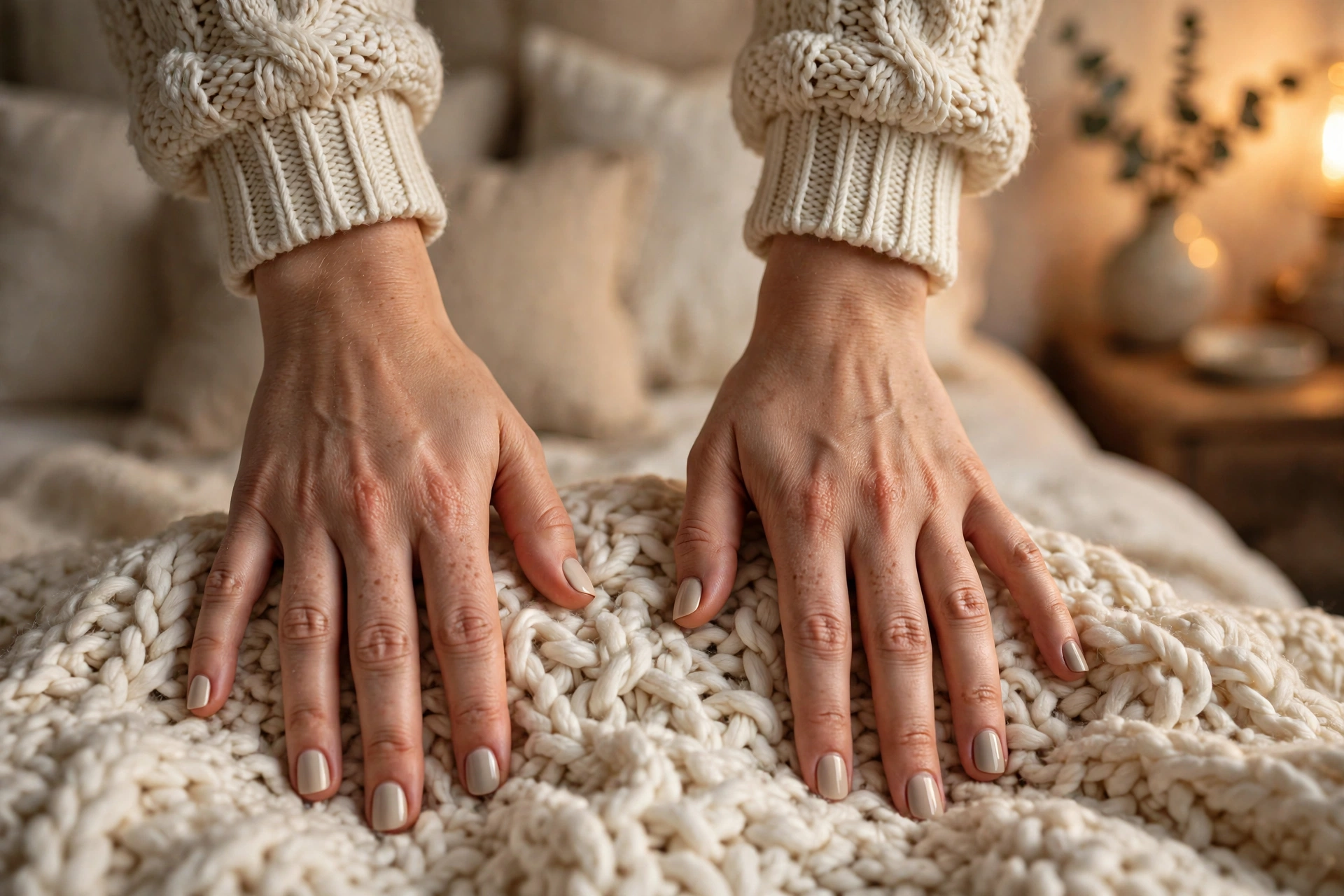
Greige, the exact midpoint between grey and beige, is the workhorse neutral for short round nails. A mid-tone creme hides chips far better than white or black, because the eye reads small imperfections as part of a muted color rather than a flaw in a stark one.
Wear it glossy for a clean, office-ready finish. Greige pairs with everything from denim to tailoring, and it is one of the few neutrals that looks equally at home on fair and deep skin tones. For a short round nail, keep the coats thin and the free edge capped with polish wrapped over the tip; that wrapped edge is what stops chips from starting.
3. Rose-Gold Glitter Cuticle Fade
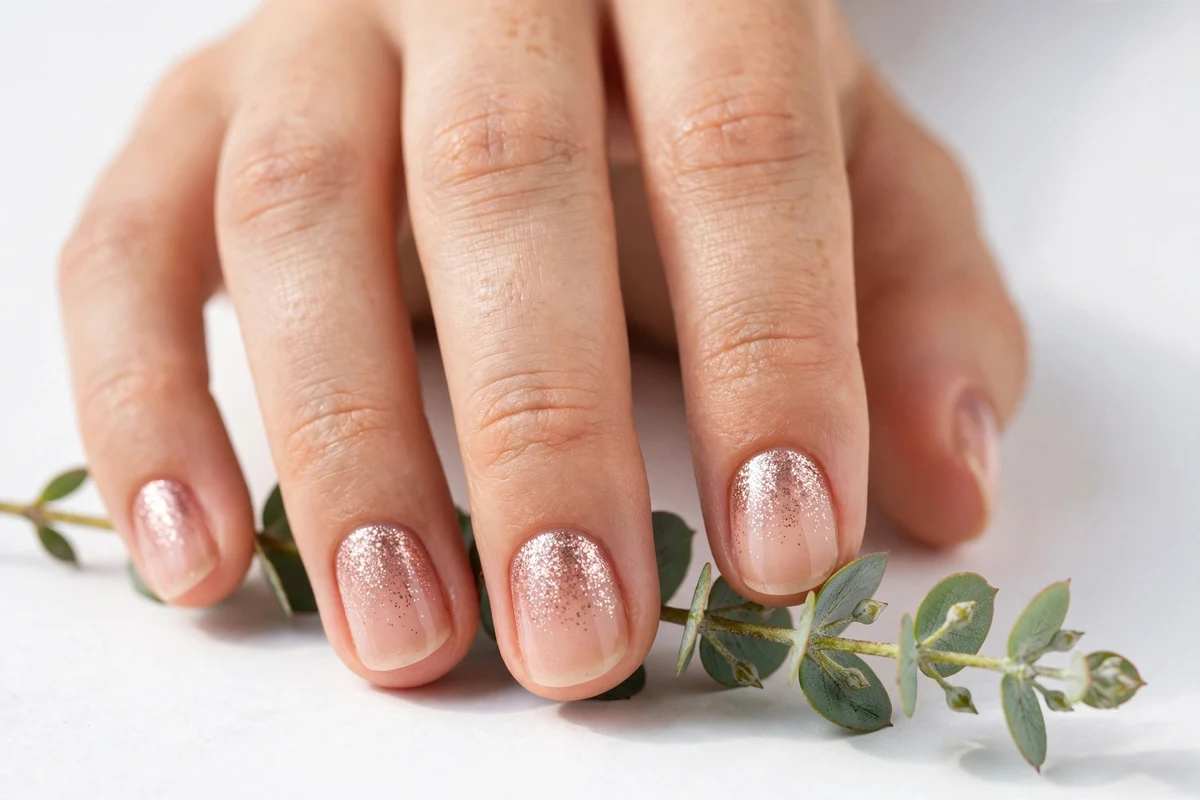
A glitter gradient that is densest at the cuticle and fades toward the tip flips the usual wear pattern. The tips, where short nails take the most abuse, are left nearly bare, so there is almost nothing there to chip.
Sponge fine rose-gold glitter onto the bottom third of a nude base and fade upward with a light touch; seal with two top coats so the glitter sits smooth. The sparkle draws the eye to the base of the nail, which also makes the nail bed look longer. This is a genuinely easy DIY: sponging is far more forgiving than painting precise art.
4. Tortoise-Shell Tips

Tortoise-shell pattern painted just on the tips over a sheer nude base hides edge wear the way camouflage hides shapes. The mottled amber and brown blobs break up the outline of the tip, so a tiny chip reads as part of the pattern.
Techs build tortoise with layered translucent browns and a thin black outline, but the at-home version is simpler: irregular blobs of caramel and chocolate over amber, blurred with a dry brush while wet. Keep the pattern to the tips rather than the full nail; on a short round nail, full-nail tortoise can look heavy, while tips keep it light and wearable.
5. Velvet Magnetic Taupe
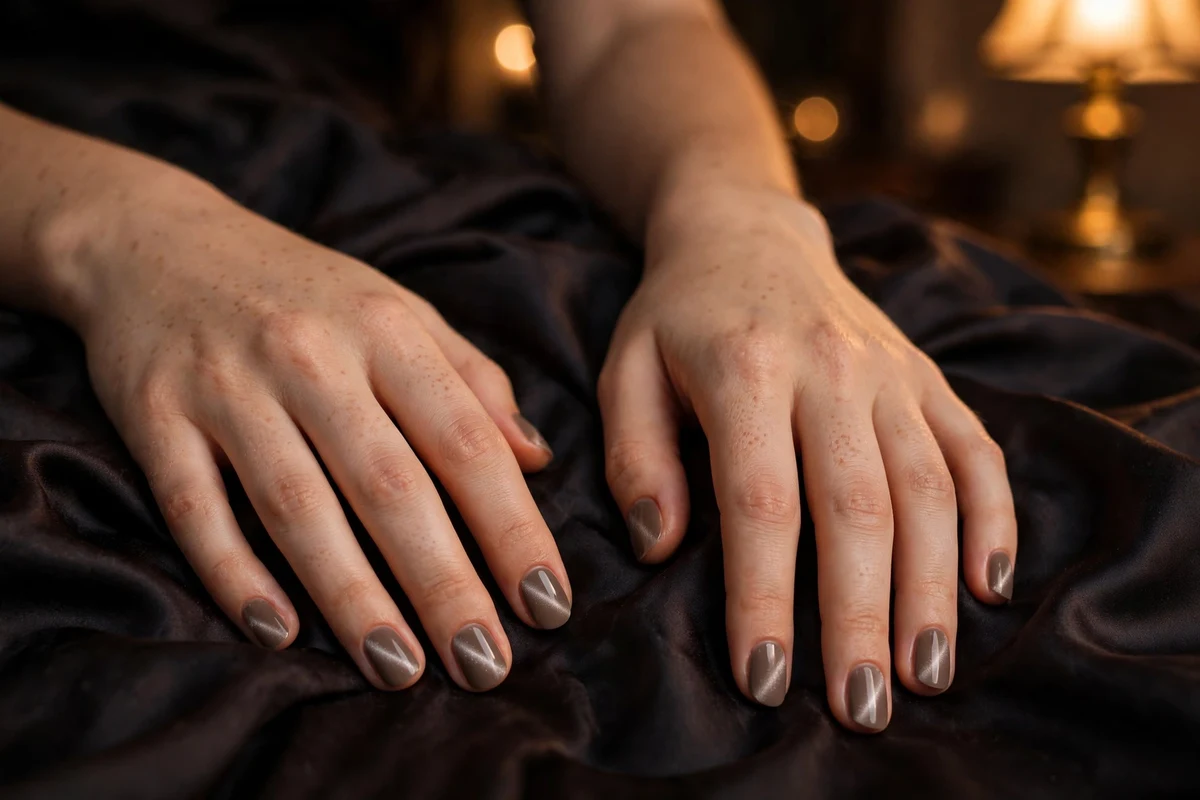
Velvet or cat-eye magnetic polish in taupe gives short round nails a shifting shimmer that disguises surface imperfections. The magnetic particles form a soft light band across the nail, and that movement distracts from any small flaw underneath.
This one needs the magnetic wand held over wet polish for ten seconds per nail, so it is a salon or practiced-DIY design rather than a first attempt. The taupe shade keeps it subtle enough for everyday wear while the velvet effect adds the interest a plain creme lacks. Expect compliments from people who cannot quite tell what they are looking at, which is the whole charm.
Designs That Elongate: Length Illusions for Short Nails
Short round nails will never be long nails, but the right design can absolutely make them look longer. Vertical lines, slim French tips, and strategic negative space all draw the eye along the nail instead of across it.
6. Classic Micro French
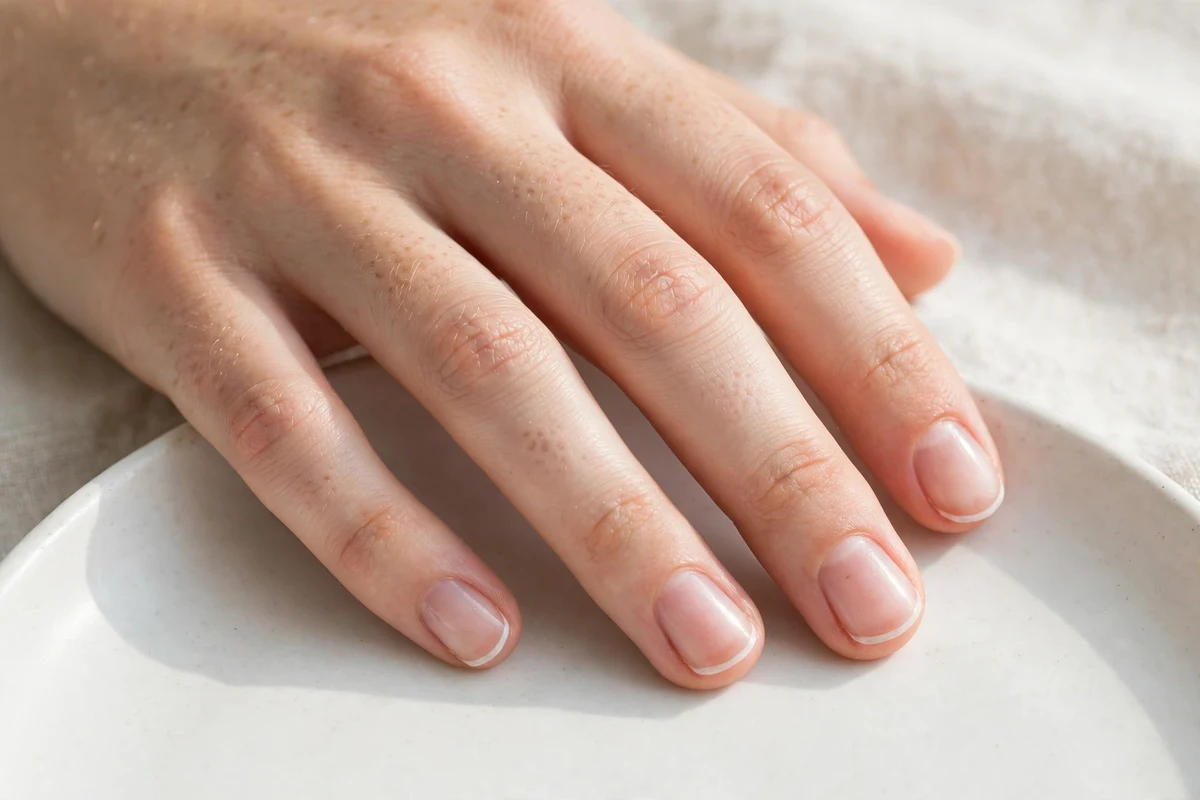
The micro French, with a white smile line just one or two millimeters wide, is the single most lengthening design for short round nails. The crisp white edge defines where the nail ends, and on a round tip the smile line follows the natural curve beautifully.
Keep the white band slim: a thick tip on a short nail shortens the visible nail bed. Ask your tech to wrap the white slightly around the edge for durability, or do it at home with French tip guides. This design suits every occasion and every skin tone, and it grows out gracefully since the base is sheer. Difficulty is moderate; the smile line takes a steady hand.
7. Bare-Sidewall Nude Stripe
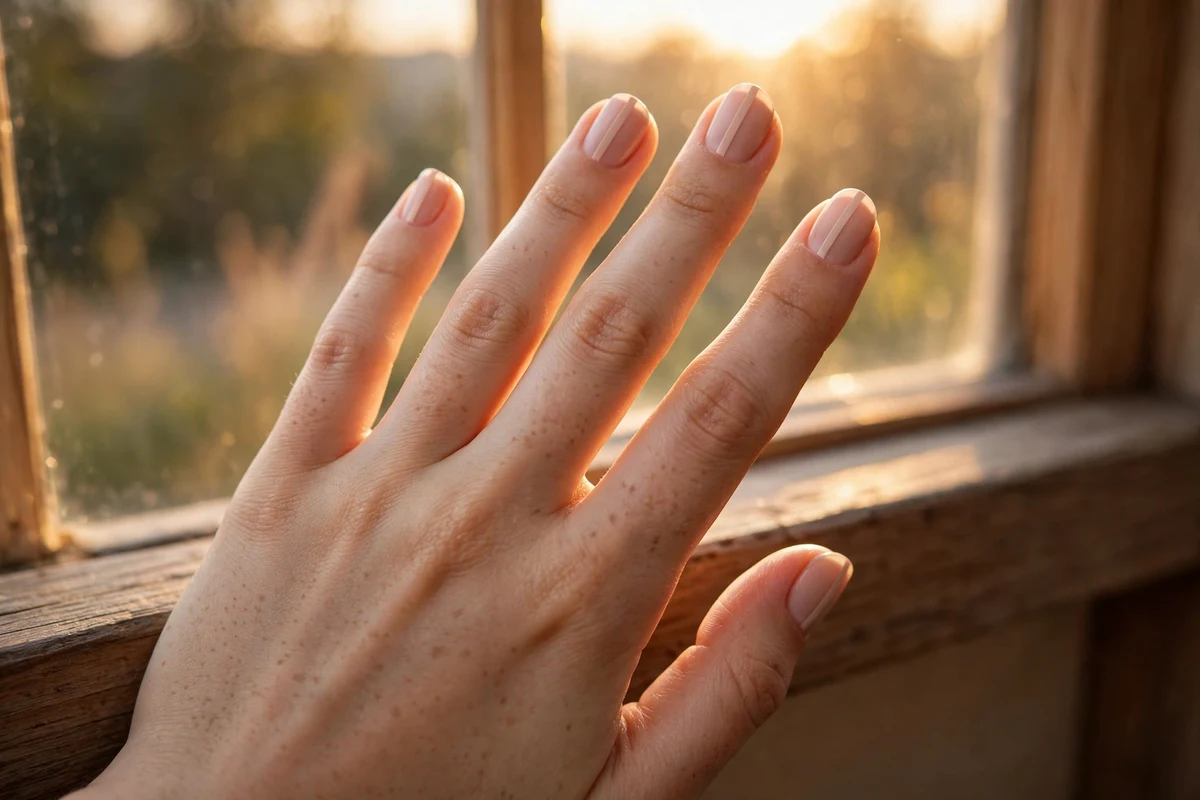
Painting a single nude stripe down the center of each nail and leaving the sidewalls bare is a slimming trick borrowed from contouring. The unpainted edges recede visually, so the nail reads narrower and longer than it is.
Choose a nude close to your skin tone and use striping tape or a steady hand to keep the center stripe even. This works best on wider nail beds, where the narrowing effect is most noticeable. It is an easy DIY with a liner brush, and the bare sidewalls mean regrowth is nearly invisible.
8. Single Vertical Gold Line

One thin vertical gold line down the center of each nude nail pulls the eye straight from cuticle to tip, which is exactly the direction you want attention to travel on a short nail. The metallic line adds a jewelry-like detail without any bulk.
Metallic striping tape gives the cleanest line with zero skill required; press it down the center and seal with top coat. A liner brush and gold polish works too but takes practice. Keep the line truly centered and slim: off-center or thick lines break the lengthening illusion. This is a strong choice for anyone who finds plain nude boring but wants to stay polished.
9. Soft Blush-to-White Ombré

A vertical ombré fading from blush pink at the cuticle to white at the tip stretches the eye along the full nail. The gradient has no hard lines to stop the gaze, so short nails read as one continuous, longer surface.
Sponge the blend in thin layers, letting each dry slightly before the next, and clean up the cuticles with a small brush dipped in remover. This is the trickiest DIY in the elongating group; salons usually airbrush it for a seamless fade. The payoff is a soft, bridal-adjacent look that flatters short fingers more than almost any solid color.
Designs That Decorate the Small Canvas: Art Scaled for Short Nails
Short nails cannot carry big art, but small art done well looks more refined than a crowded long nail. These five designs keep every element tiny and deliberate, which is the golden rule for decorating a short round nail.
10. Micro Dot Trio
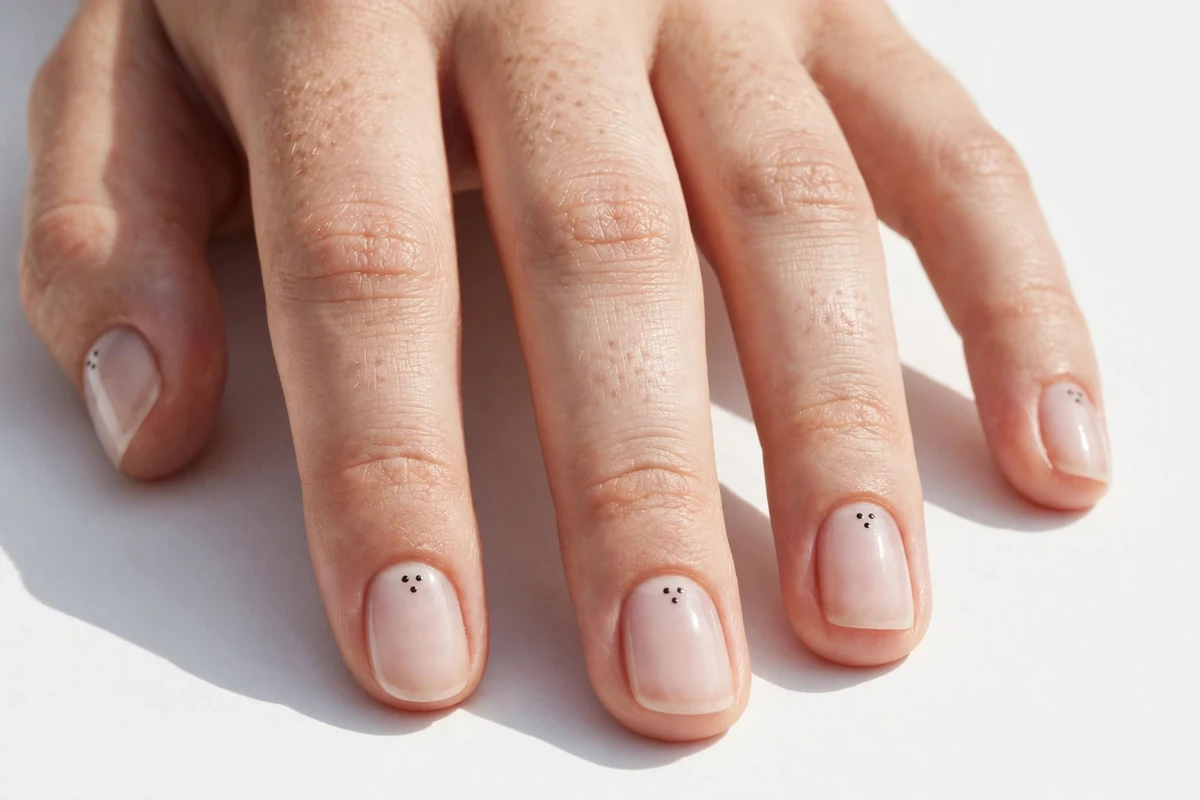
Three tiny dots arranged in a small triangle near the cuticle is the smallest possible nail art, and on a short round nail that restraint is the point. The dots add personality without overwhelming the nail’s small surface.
Use a dotting tool or the rounded end of a bobby pin; black dots on a milky base is the classic combination. Keep the dots genuinely small, about a millimeter, and place them close to the cuticle so the tip stays clean. This is a perfect first nail-art attempt. For more dot inspiration, browse our polka dot nail designs.
11. Tiny Daisy Accents
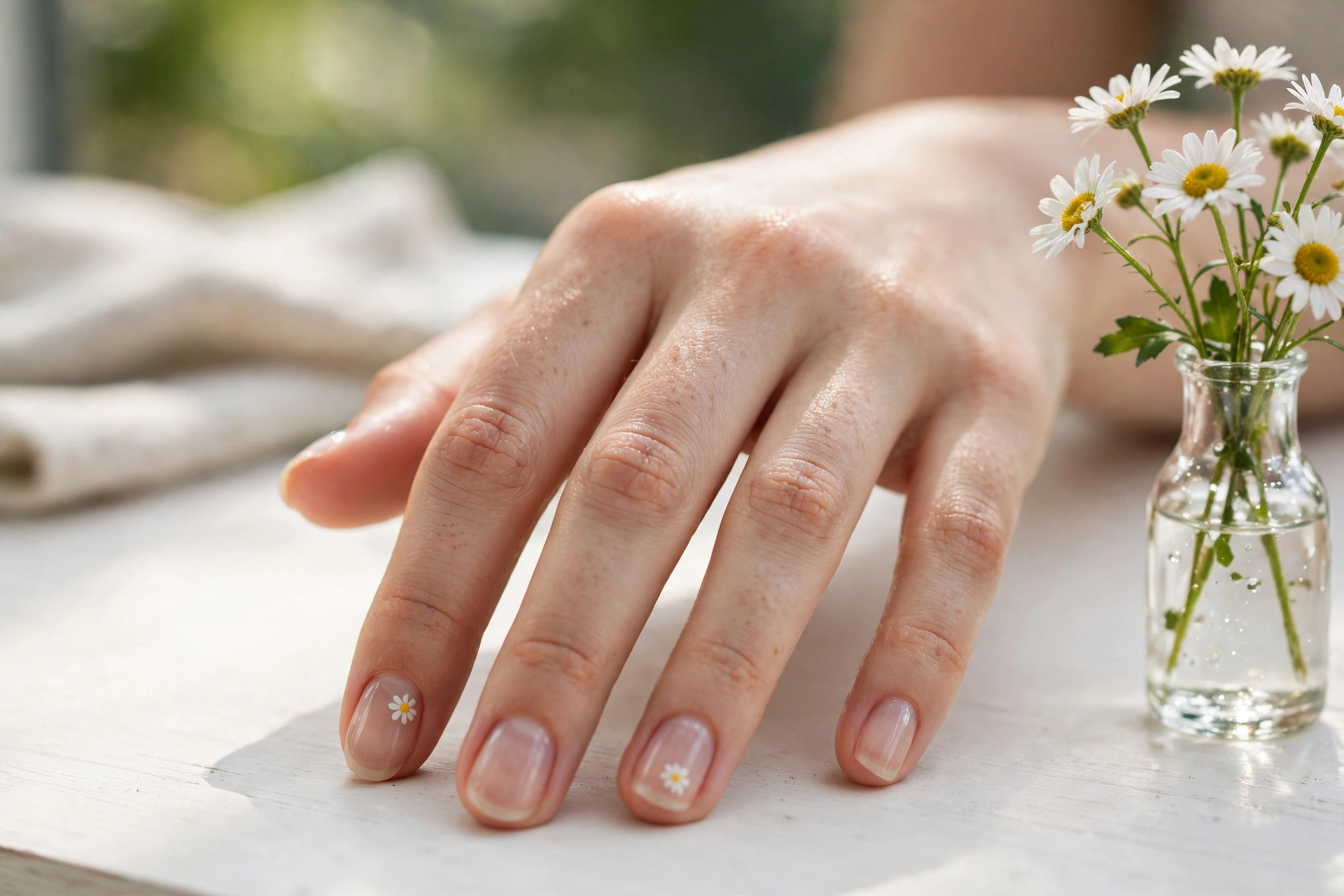
One small daisy per accent nail, painted with five tiny white petals around a yellow center, brings a hand-painted feel to short round nails. Keeping the florals to two accent nails per hand stops the design from feeling busy.
Paint the daisy with a dotting tool: five white dots in a circle, one yellow dot in the middle. Keep each flower under a third of the nail’s width; oversized florals are the most common reason short-nail art looks cluttered. This is a lovely spring and summer choice. More floral ideas live in our floral nail designs guide.
12. Gold Foil Flecks on Nude
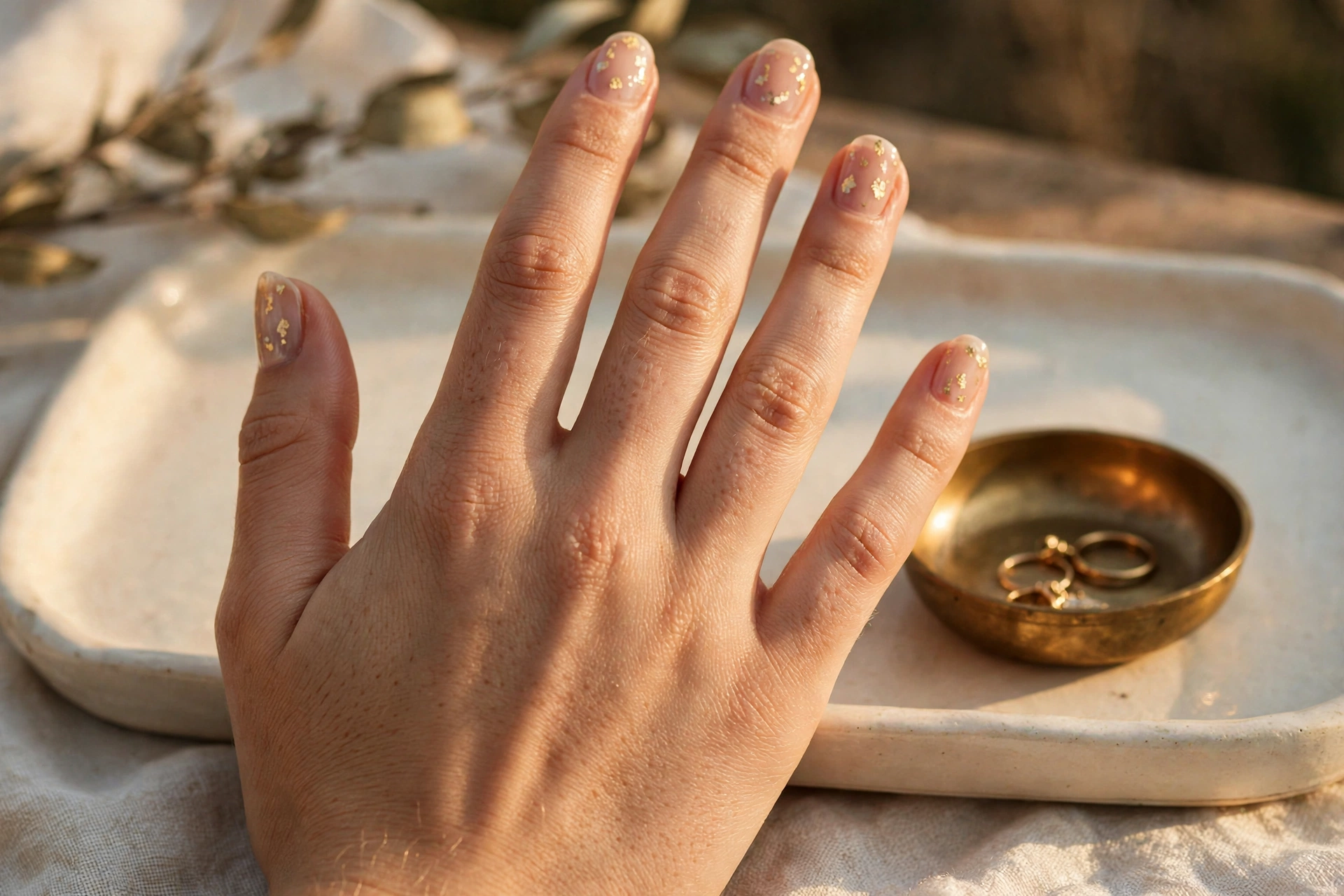
Scattered gold foil flecks concentrated near the cuticle give nude nails a gilded, jewelry-like finish. Because each nail lands differently, the manicure looks custom and artful with almost no effort.
Press foil pieces onto the tacky layer of gel or onto barely-dry polish, then seal with two top coats so no edge lifts. Restraint is everything: a few flecks near the cuticle reads chic, while full coverage reads messy on a short nail. This design photographs beautifully and suits evenings and occasions especially well.
13. Single-Line Half-Moon
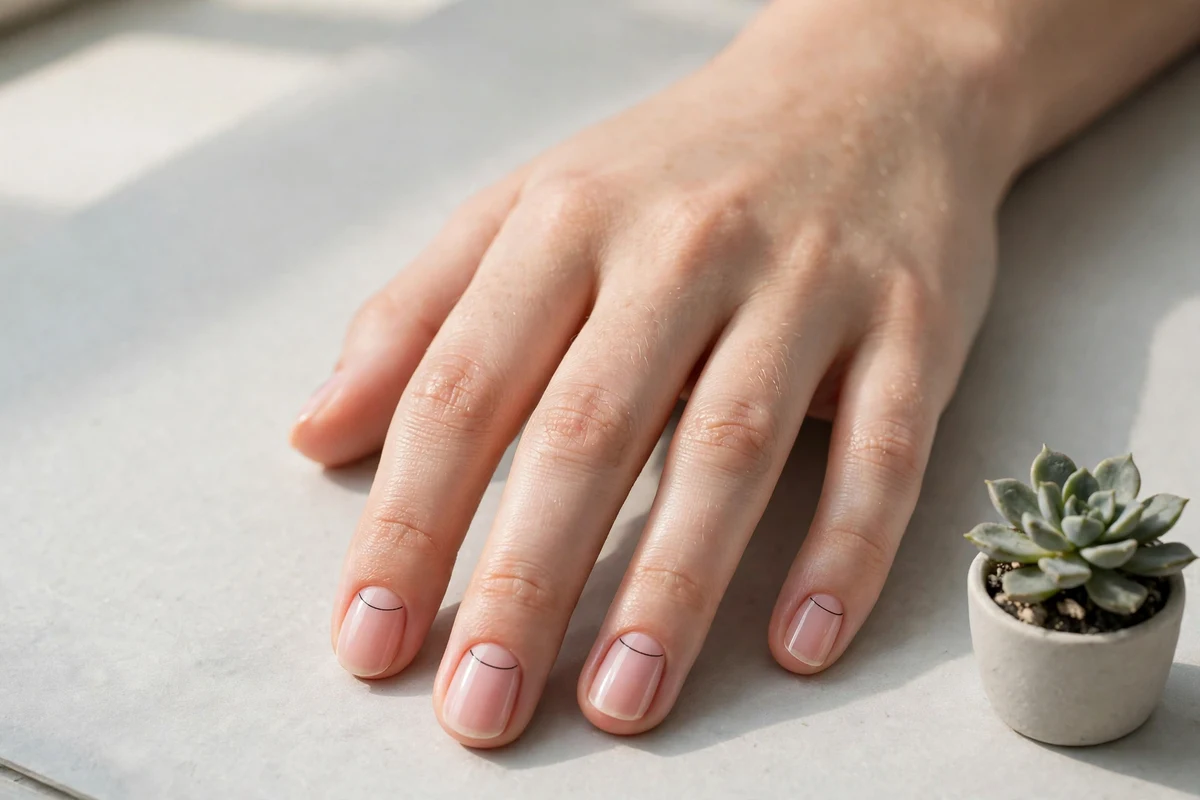
A single thin curved line echoing the cuticle, painted in black over sheer blush, is minimalist art that works with the round shape instead of against it. The curve mirrors both the cuticle and the round tip, tying the whole nail together.
A liner brush and a steady hand are all this needs; the line should sit a couple of millimeters above the cuticle and follow its arc. Because the design lives near the base, tip wear barely touches it, so it stays crisp for the life of the manicure. This is one of the most office-friendly art options here.
14. Mini Checker Accent Nail
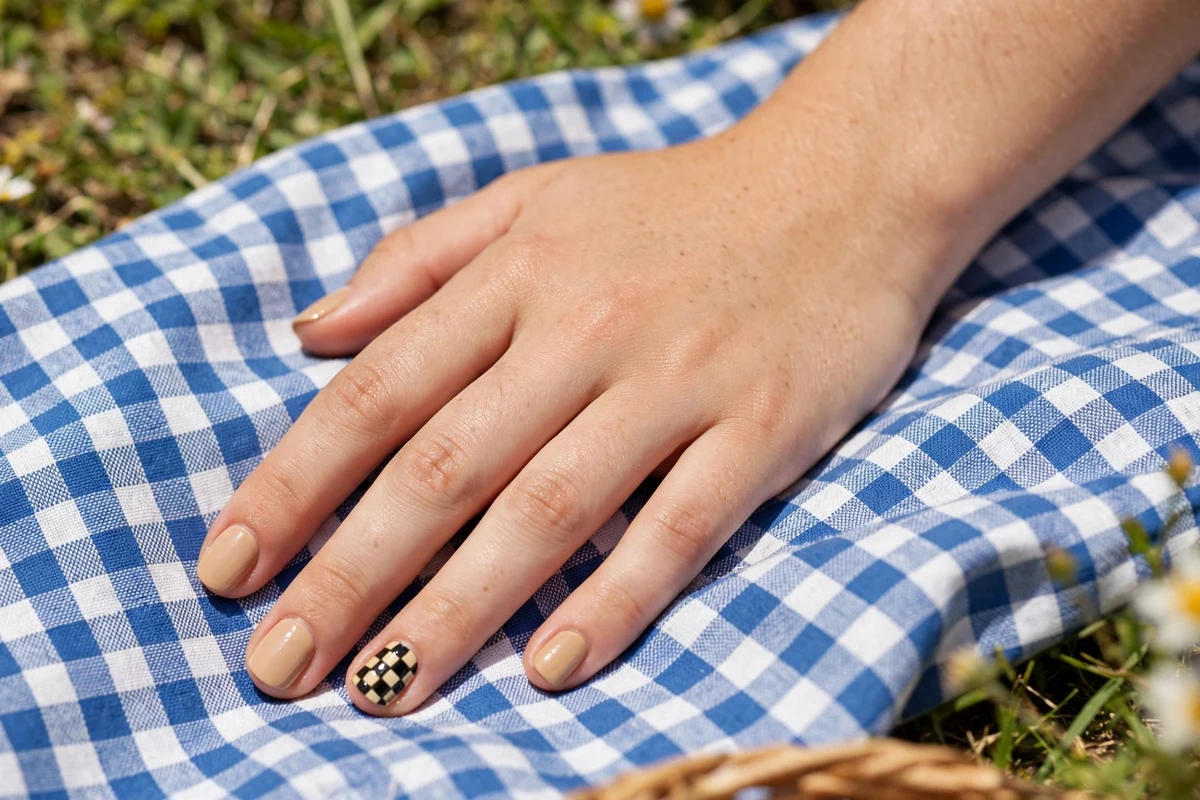
A tiny checkerboard on a single accent nail, surrounded by plain warm beige nails, delivers a retro wink without committing the whole hand to a pattern. On a short round nail, the small checks fit the canvas in a way they never quite do on long nails.
Paint the checker with a liner brush in black and cream, keeping each square small and even; two accent nails per hand is the maximum before it tips into busy. This is an intermediate DIY, but the plain surrounding nails forgive a slightly wobbly grid. It is a fun weekend design that still looks intentional on Monday.
Designs That Coast: Looks That Last Three Weeks
Some designs are built to age well. Sheer bases, cuticle-focused art, and natural-looking overlays all blur the regrowth line, so the manicure looks deliberate long after a solid color would be begging for removal.
15. Sheer Glazed Chrome
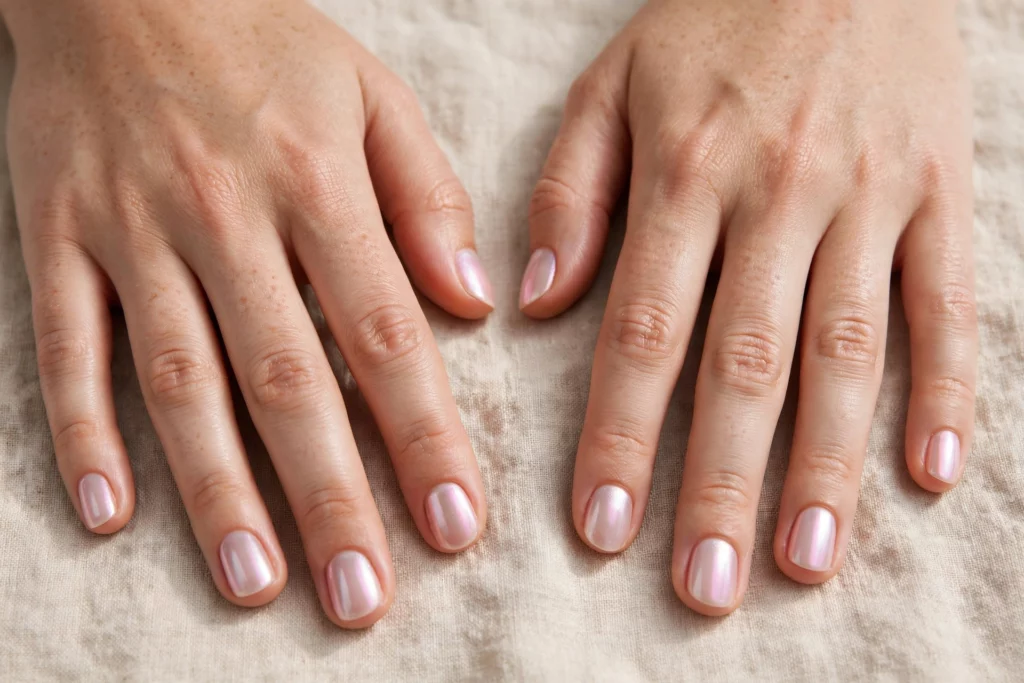
The glazed donut effect, sheer polish rubbed with chrome powder, is a grow-out champion. The translucent base means the regrowth line at the cuticle is nearly invisible, and the chrome glow keeps the whole nail looking luminous for weeks.
Two thin coats of sheer pink or milky white, chrome powder buffed on top, sealed with a no-wipe top coat: that is the whole recipe, and it is genuinely DIY-friendly. Keep the base sheer rather than opaque, or the glaze loses its glassy quality. Explore the full technique in our glazed donut nail ideas.
16. Cuticle Cuff in Deep Berry
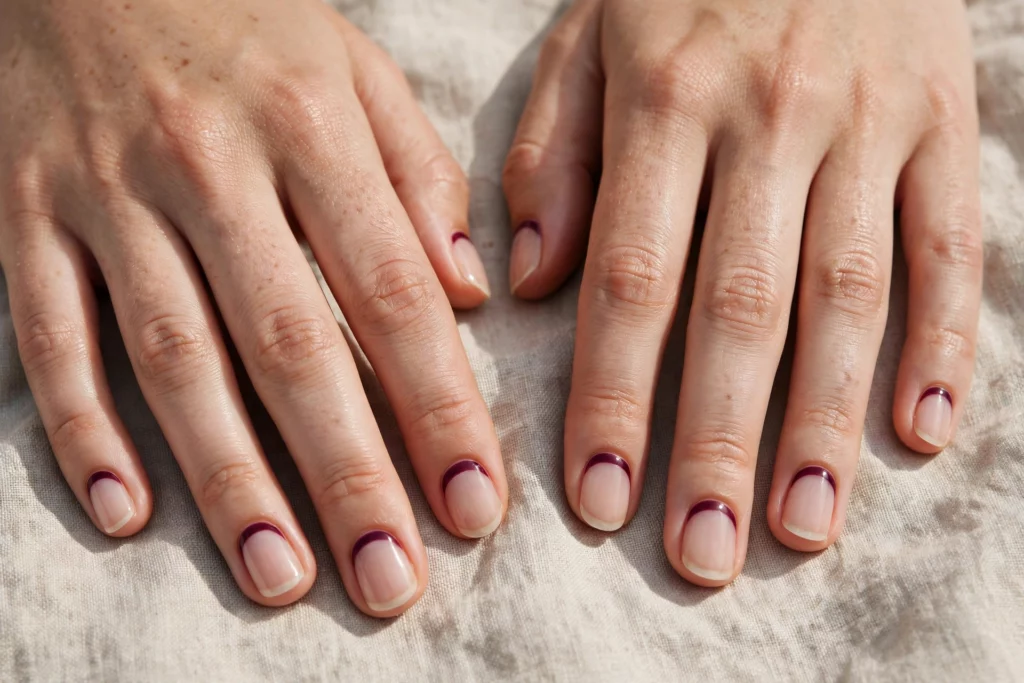
A reverse French, a curved band of deep berry painted along the cuticle over a sheer nude base, grows out more gracefully than any tip design. As the nail grows, the colored band simply travels with it, still looking like a deliberate design rather than regrowth.
Paint the cuff with a liner brush, following the cuticle’s curve a few millimeters out. Berry and oxblood shades give the most striking contrast against sheer nude. This is a moderate-difficulty DIY, but the forgiving grow-out makes it worth learning; it is one of the longest-wearing art designs you can choose.
17. Glitter Cuticle Crescent
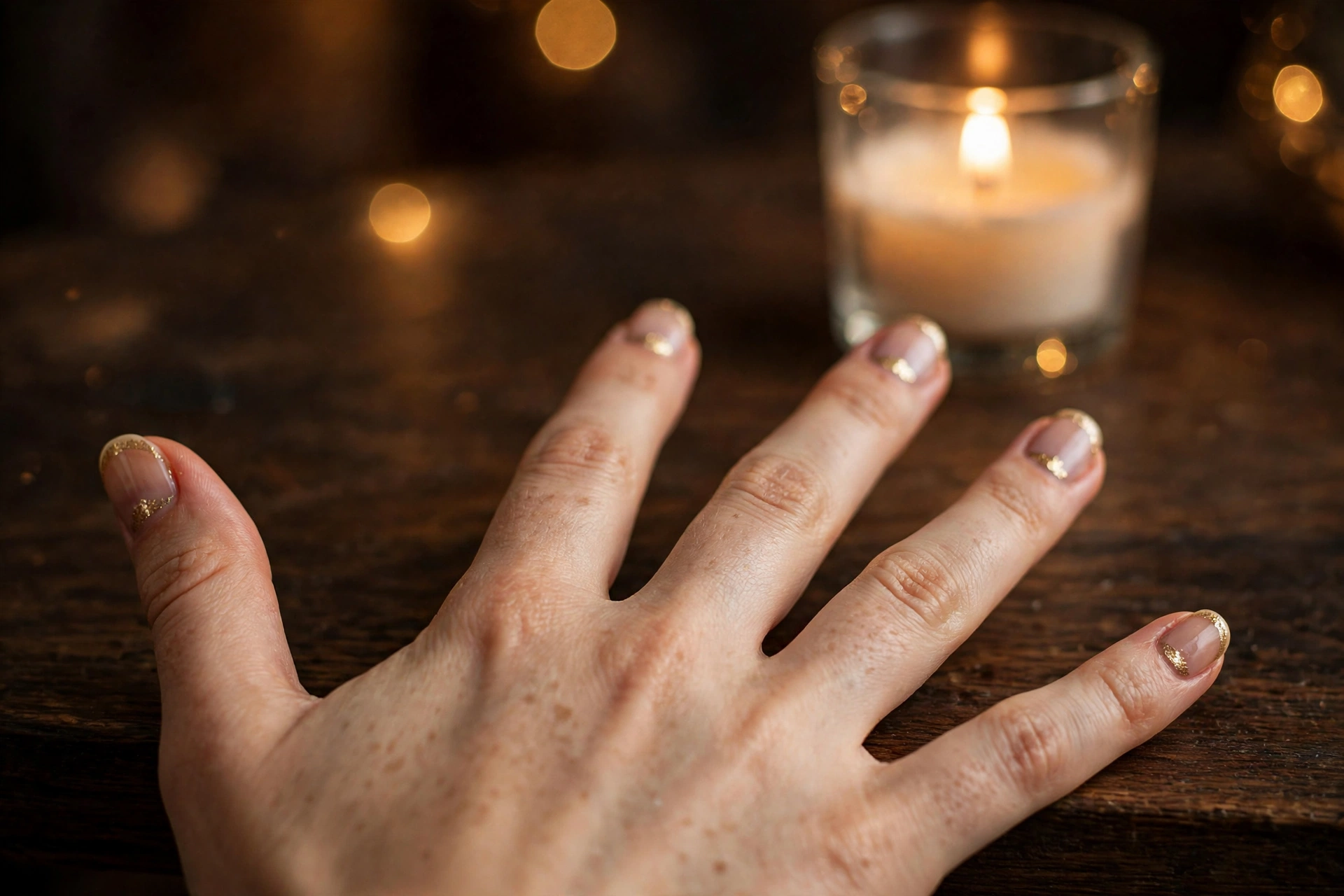
A fine gold glitter crescent hugging each cuticle over bare, natural-looking nails works like jewelry for the nail base. The glitter sits exactly where regrowth appears, so it camouflages the grow-out line while adding sparkle.
Use fine glitter rather than chunky, painted in a thin crescent with a small brush, and seal thoroughly. On completely bare nails this reads as subtle; over a sheer nude it reads as polished. This is an easy DIY and a smart choice for the weeks between salon appointments.
18. Sheer Builder Overlay

A sheer beige builder-gel overlay is less a design than a strategy: a thin layer of strengthening gel in a your-nails-but-better tint that protects short nails while looking completely natural. It is the practical reader’s secret weapon.
Builder gel adds real strength, which matters because short nails that peel and split never get the chance to look good. The sheer tint evens out ridges and discoloration while the regrowth line stays soft for weeks. This is a salon service rather than a DIY, but for anyone whose nails break before they ever look nice, it changes the game. See our natural nail designs for more barely-there looks.
The Best Colors for Short Round Nails
Color does more work on a short nail than on a long one, because there is less nail to look at: the wrong shade can shrink it further, and the right one can quietly add the length the shape gives up. Two rules cover most hands. First, shades close to your skin tone elongate, because the nail reads as a continuation of the finger; milky pinks, sheer nudes, and greiges matched to your undertone are the most lengthening colors you can wear on round nails. Second, very dark polish on a very short nail shortens it visually, since the eye stops at the hard edge of color. Deep shades still work beautifully on round nails, but wear them when the nails have at least a sliver of free edge, and keep the finish glossy so the edge catches light.
Match the undertone, not just the depth. Warm undertones suit peachy nudes, caramel, terracotta, and warm reds; cool undertones suit rose, mauve, greige, and blue-based reds. Fair skin can wear almost any sheer without it washing out, but should give muddy yellow-beiges a miss. Medium and olive skin carry warm mid-tones best: cinnamon, soft coral, and warm taupe all read expensive on a round shape. Deep skin is where round nails get their widest color range: bright whites, jewel tones, and metallics all pop against the small curved canvas, and a sheer milky wash gives the same lit-from-within effect it gives fair skin. If a shade looks slightly off in the bottle, it will look more off on a short nail; when in doubt, go one step sheerer.
Season helps narrow it further. Spring suits the sheer pinks and tiny florals already in this guide; summer takes the bright cremes and the mini checker; autumn is tortoise, greige, and deep berry weather; winter is when the velvet magnetic and glazed chrome finishes earn their keep, because short days and indoor light reward anything that moves or glows.
Round Nails vs the Other Short-Nail Shapes
Round is not the only shape that works short. This comparison covers the shapes readers weigh against round most often, so you can pick with open eyes.
| Shape | Tip profile | Durability at short lengths | Length illusion | Best for |
|---|---|---|---|---|
| Round | Curved, follows fingertip | Highest; no corners to catch | Low; honest about shortness | Active lifestyles, growing out damage, lowest maintenance |
| Oval | Egg-shaped, extends past fingertip | High, needs a little length | Moderate | A softer look with a touch more elegance |
| Almond | Rounded point | Moderate; tip can snap | High | Slimming fingers while staying wearable |
| Square | Flat with sharp corners | Moderate; corners chip | Low | Crisp French tips and graphic art |
| Squoval | Flat with softened corners | High; corners blunted | Low to moderate | Square lovers who are tired of chips |
Round wins on pure practicality and loses on drama; that is the honest trade. If you want the round shape’s durability with a slightly dressier silhouette, squoval is the closest alternative. If you want fingers to look longer above all else, almond nail designs are worth a look, with the understanding that the pointed tip needs more care.
Gel, Regular Polish, or Press-Ons: How Round Wears in Each
The round shape is medium-agnostic, but the medium changes how long these designs last and which ones make sense. Regular polish on short round nails gives you five to seven good days: the curved edge sheds chips better than any other shape, and the chip-forgiving designs above stretch that to the full week. It is the right choice if you like changing colors often or are keeping chemicals off recovering nails.
Gel polish is where round quietly outperforms. Because there are no corners to lift, a gel manicure on round nails regularly reaches three weeks without the edge failures that end almond and square sets early, and the cuticle-focused designs (16 and 17) hide the regrowth when it comes. If your nails themselves are weak, a sheer builder-gel overlay (design 18) adds structure that lacquer cannot; ask for the builder kept thin so the round silhouette stays delicate rather than bulky.
Press-ons are the shortcut worth knowing about: round and short-round tips are the most natural-looking press-on shape, and the easiest to file down to a true round if the tip runs oval. Size them to cover the nail without overhang at the sidewalls, since excess width is what makes press-ons read as fake at short lengths. Whichever medium you choose, the shape underneath does the same job: no corners, no leverage, nothing to catch.
Keeping Short Round Nails Strong
Short nails break less than long ones, but they still need basic care to look good. The round shape does half the work; these habits do the rest.
Oil the cuticles daily: flexible nails bend instead of snapping, and cuticle oil is the cheapest strength treatment there is. File instead of clipping when you maintain the shape, since clippers can cause micro-cracks in the free edge that later become splits. Wear gloves for dishes and cleaning, because prolonged water and detergent exposure softens nails and lifts polish. And if your nails peel no matter what you do, ask your salon about a sheer builder overlay (see design 18 above): it adds a protective layer that lets weak nails grow out underneath instead of breaking at the same length forever.
Put those habits on a rhythm and the shape mostly maintains itself. On day three or four, add one fresh layer of top coat: it reseals the free edge where chips start and restores the gloss, and it takes two minutes. Once a week, re-file the curve, briefly and in one direction, before it grows out into corners; a round shape lost to growth is the main reason short nails start catching. Oil cuticles daily, ideally after washing your hands, when the nail is slightly hydrated and absorbs it best. And every few weeks, give the nails one polish-free day between manicures. Nails do not need to breathe, but the break lets you inspect the nail plate for peeling or discoloration that polish would hide.
Frequently Asked Questions
What is the difference between round and oval nails?
Round nails are short with a curved tip that follows the fingertip; oval nails are longer, with the sides tapering into an egg-shaped tip that extends past the fingertip. Round is the stronger, lower-maintenance shape, while oval looks more elongating but needs more length.
Are round nails good for short nails?
Yes, round is arguably the best shape for short nails. The curved edge has no corners to chip, the short length keeps leverage low so breaks are rare, and the shape suits natural nails without extensions. It is the shape nail techs recommend for growing out bitten or damaged nails.
Do round nails make fingers look shorter?
They can, compared to almond or oval, because the shape adds no visual length. Designs that elongate, like a micro French, vertical lines, or a blush-to-white ombré, counteract this. But round nails are honest: they prioritize neatness and durability over the illusion of length.
What nail designs look best on short round nails?
Designs that respect the small canvas: sheer washes, micro French tips, tiny dots and florals, thin vertical lines, and cuticle-focused art. Keep every element small and avoid covering the whole nail in busy patterns, which can look crowded at short lengths.
Are round nails stronger than square nails?
At short lengths, yes. Square nails have corners that catch on fabric and chip, while the round shape’s continuous curve distributes stress evenly with nothing to snag. This is why round is the standard recommendation for people whose nails break easily.
Can you do French tips on short round nails?
Absolutely, and the round tip suits French tips well since the smile line follows the natural curve. Keep the white band slim, one to two millimeters, so the nail bed still looks long, and wrap the white slightly around the edge for durability.
How do I file my nails into a round shape at home?
Trim straight across first, then file the corners in smooth one-direction strokes from the side toward the center, checking the curve against your fingertip. Use a fine-grit file, avoid sawing back and forth, keep the free edge short, and finish with a buffer. File every week or two to hold the curve as nails grow.
Do round nails break easily?
No, round is the hardest shape to break at short lengths. The continuous curve has no corners to catch or stress points to snap, and the short free edge gives knocks very little leverage. If your round nails are breaking, the cause is almost never the shape; it is usually dehydration, peeling layers, or filing with a sawing motion, all of which the care routine above addresses.
What colors look best on short round nails?
Sheer milky pinks, skin-matched nudes, and greiges look best if you want length, because they blur the line between finger and nail. For color with presence, glossy mid-tones like rose, cinnamon, and soft coral flatter the shape without shrinking it. Very dark shades work too, but wear them glossy and with a sliver of free edge so the nail does not read shorter than it is.
Are round nails a good choice for a wedding?
Yes, especially if you want your hands to look neat in close-up photographs without competing with a ring. The micro French (design 6), the blush-to-white ombré (design 9), and the sheer glazed chrome (design 15) are the three most bridal designs in this guide. Round is also the safest shape for a wedding week: it is the least likely to chip, snag on fabric, or need an emergency repair.
Round vs square nails: which should I choose?
Choose round if your nails break easily, your lifestyle is hands-on, or you want the lowest-maintenance short shape; the curve cannot catch or chip at a corner it does not have. Choose square if you prefer a crisper, more graphic edge and mostly wear French tips or geometric art, and accept that the corners will need more care. If you like square’s look but not its chips, squoval is the deliberate compromise, as the comparison table above shows.
Round nails prove that practical and pretty are not opposites. For more shape inspiration, explore our complete nail shapes guide, or browse minimalist nail designs and nude nail designs for looks that pair beautifully with the round silhouette.